

Can You Wallpaper a Ceiling?
Yes, you can wallpaper a ceiling. 2026 is the year designers stopped treating it as a niche move. The "fifth wall" is having a real moment in home interior design, with the powder room, the dining room, and the primary bedroom leading the way. The install is harder than a regular wall (gravity works against you the whole time, and lighting from below highlights every flaw), but adding wallpaper overhead can transform a room in a way no paint color can.
This guide covers when wallpapering a ceiling is a good idea, which ceilings work and which do not, what wallpaper for ceiling work fits each room, the rooms where it shines, and the installation steps if you want to tackle the project yourself or hire a professional wallpaper installer.
Is Wallpapering the Ceiling a Good Design Idea?
More and more, yes. In the last three years the wallpaper ceiling treatment went from a quirky choice to a mainstream interior feature. Author Katelin Hill, writing in Bob Vila's "7 Things to Know Before You Wallpaper the Ceiling", frames the ceiling as "where it's least expected, for a high dose of drama." That's about right.
Walk into a room with pattern overhead and you'll look up before you've even set your bag down. The room feels taller. It feels like somebody meant it, too, and that vertical lift makes even a small space feel like an experience. You get visual depth without giving up any floor or wall space. A print up there is a finishing touch, the way a painting is on a wall, and it's why ceiling wallpaper makes a room look custom rather than builder-grade.
Small rooms get the most from it. On a powder room or dining room ceiling, pattern becomes a fifth feature wall, so you get a designed look without committing the whole room to it. Painted walls make a good partner here. Save the bold print for the ceiling and leave the walls neutral; the contrast does the rest. Even a floral or delicate print overhead can sit above quiet trim and still feel grounded.
Wallpapering the ceiling has real downsides, though. Getting paper to lie flat over your head is harder than hanging a wall. Some ceilings rule it out before you've bought a single roll, popcorn most obviously (heavy texture or old water damage puts you in the same spot). Removal years from now is a bigger chore than on a wall, too. And it doesn't suit every room. An open kitchen with a tall ceiling rarely gains anything from it, and in a small bedroom, strong lighting on a busy pattern can be overwhelming.
Not sure wallpaper in general is a smart call in 2026? Our piece on Is Wallpaper Back in Style? gets into that, and wallpapered ceilings are one of the defining 2026 trends it calls out.
Will Wallpaper Stick to a Ceiling and Stay Up?
Yes, on the right surface. The adhesive that holds paper to a wall holds it to a ceiling just as well, so the bond itself isn't really in doubt. The surface is.
Smooth, primed drywall is the easy case. Older plaster gets there once it's been cleaned and primed. A lightly textured ceiling can take paste-the-wall non-woven, but only if it's very light orange peel, the kind you feel more than see.
Then there are the ceilings that fight you. Popcorn blocks a proper bond, so it has to be scraped off, and the ceiling skim coated and primed, before any wallpaper goes up. Knockdown and other heavy textures have the same issue and need a skim coat first. A water stain means something leaked. Fix the cause, then cover the mark with stain-blocking primer before you hang anything. Glossy or semi-gloss paint is too slick for wallpaper paste to bond to, which a light sanding and a coat of primer will sort out. Acoustic tile? Forget it. That porous tile surface won't accept wallpaper.
If your ceiling is one of those harder cases, the prep is heavy enough that a pro installer often makes more sense than DIY. Skip it on a popcorn or water-damaged ceiling and a one-day project can drag into a multi-week nightmare.
Best Ceiling Wallpaper Types
Three types are real candidates for ceiling installation.
The favorite is non-woven paste the wall. Its backing is stable, so it won't expand or shrink partway through the install, which matters with a strip a foot from your face. The paste goes on the ceiling, not the paper, so the bond is strong, and the heavier weight grips against gravity. Most top ceiling installs use non-woven. Pair it with a glue or paste suited for heavy paper and the bond holds upward against the pull.
Prepasted can work up there. The trouble is that you soak it first, so now you're lifting a heavy, wet strip over your head and trying to slide it across the ceiling. Drips are almost a given.
Peel and stick is workable on a short ceiling in a small room. Its weak spot is the pressure-sensitive adhesive, which can lift over time on an overhead surface, most of all in a bathroom or any other humid room. On a wall, repositioning is the whole appeal. On a ceiling it's a liability, since the paper can shift under its own weight. That's why we'd call non-woven the safer pick.
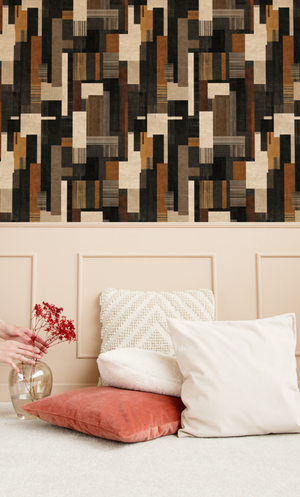
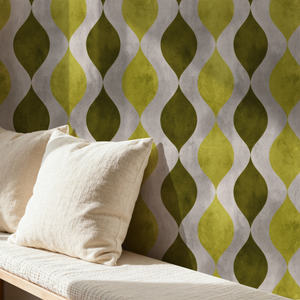
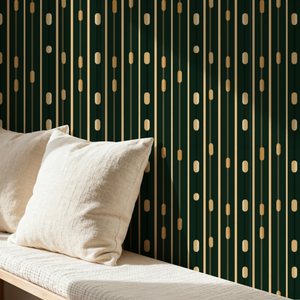
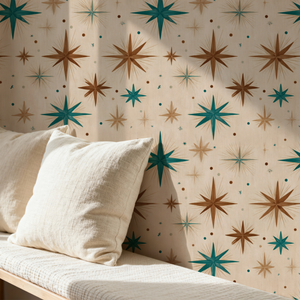
Pattern counts as much as material. A small-scale repeat or a busy pattern hides alignment flaws better than a large design does. Stripes go the other way. Tight stripes and geometric patterns magnify any drift, and a wandering stripe is one you'll see every time you look up. Think about the light, too. Harsh overhead lighting will show every seam on a bold pattern, while a delicate floral or a soft cloth-look weave hides minor seams better than a graphic line print.
Best Rooms for a Wallpapered Ceiling
Some rooms gain more from a wallpapered ceiling than others.
The powder room tops the list. It's the single best room for ceiling wallpaper. The space is small and the impact is big. With no shower in there, you've also got no humidity to worry about. Guests notice it, too, because in a room that small there is not much else to look at. One project takes the room from utility to small jewel box.
Dining rooms come next. Eyes drift upward over a meal (you've probably caught yourself doing it), and a patterned ceiling gives them somewhere to land without fighting the table talk or the art on the walls.
In a bedroom, start with the canopy area above the headboard, or take it across the whole ceiling in a primary suite. Bedroom ceiling wallpaper reads as cozy rather than busy, more so under soft, warm lighting. Nurseries and kids' rooms are where wallpaper gets playful without feeling heavy. Over a crib, ceiling murals of clouds give someone small something to stare up at, and stars or soft florals work too. Any of them gives the room a calm, magical feel.
A living room with a low to mid-height ceiling is another good fit, since pattern up there over simple trim looks quietly polished, not like a stunt. In a hallway or entryway the ceiling defines the corridor, and in a long one, pattern overhead can change an otherwise plain space. Built-in nooks work as well. Over a banquette the ceiling area is small enough that pattern feels intentional and contained, and the same goes for a reading corner or a dining alcove.
Where would we skip ceiling wallpaper? A bathroom with poor airflow is the big one, since the humidity will lift the corners within months. Not right above a kitchen stove either, where heat and grease will damage it. An open-plan room with a tall ceiling already feels tall, so pattern up there reads as too much. And a basement with moisture issues needs the moisture fixed first.




Can You Wallpaper a Textured Ceiling?
Mostly no, not without prep. Run your palm across it. A very light orange peel can sometimes take paste-the-wall non-woven if you use a thicker backing. Anything heavier will show through the wallpaper or block the bond. Knockdown does it, and so do popcorn, swirl and slap brush.
That leaves three real options. The first is to skim coat the ceiling flat. Joint compound goes on in thin layers and gets sanded smooth between coats, which takes one to two days for a typical room and $40 to $80 in materials (plus fine white dust in your hair). If it's popcorn, you can scrape and redo instead. Once the popcorn's been wet-scraped off and the drywall is repaired and primed, you've got a smooth ceiling ready for wallpaper. Or you skip wallpaper for that ceiling. Paint the texture, or live with it.
One warning before you pick up that scraper. In homes built before 1980, popcorn texture often contains asbestos, so have it tested first. Asbestos-containing popcorn needs licensed abatement, not DIY removal. For broader prep guidance on textured surfaces, see our guide on Can You Put Wallpaper on Textured Walls?, since the same rules apply to ceilings.
What Makers Recommend for Ceiling Install
A ceiling installation asks more of the adhesive than a wall. Every minute the paper's up there, gravity is pulling on it, so if you want wallpaper to stick to a ceiling, the surface prep rules in maker guides matter more, not less. The Tempaper "Frequently Asked Questions" page calls for install on smooth surfaces "primed and painted with an eggshell, satin or semi-gloss paint." On a ceiling, that same eggshell or satin finish gives you the best shot at paper that's still holding years from now.
It's also why an interior designer or experienced installer will look hard at the room's lighting and structure before committing to a pattern. Strong light from overhead shows every seam. And joist lines that aren't even can pull a precise seam off-axis.
How to Wallpaper a Ceiling Yourself: Step by Step
The basic method is the same as for a wall, with three big differences. Gravity is pulling on every strip the whole time you're up there. Your arms stay up and your neck stays craned back for hours. Then the pattern has to line up with the walls below, which adds work. Plan 3 to 5 hours for a typical room.
Before you climb anything, gather the wallpaper rolls (non-woven paste-the-wall is best) and wallpaper paste, with a paste roller or brush. A sturdy step ladder works, but a small scaffold is better and safer when your arms will be over your head that long. You'll want a 4-foot level and a chalk line, plus a plastic smoother, and for trimming, a sharp utility knife with extra blades and a 6-inch straight edge. Drop cloths go down because paste drips will happen. The last item isn't a tool. It's a second set of hands (strongly suggested) or a hired installer.
Prep comes first. Once the ceiling is clean and any cracks are fixed, prime it with wallpaper primer and let that cure 24 hours. Just painted the ceiling? Then wait 30 days before wallpapering.
Next, decide which way the strips run. You want the direction that gives the fewest seams and hides pattern drift in shadow, and in most rooms that's parallel to the longest wall. Snap a chalk line on the ceiling along your starting edge. That line is your reference for the whole job, so trust it over the wall corner, which may not be plumb at all.
Cut your first strip to the ceiling length plus 4 inches. Paste the ceiling along that strip's path, slightly wider than the strip, so the edges land on paste. This is where your partner earns their keep. The two of you lift the dry strip up together, and while one lines the leading edge up to the chalk line, the other supports the trailing end. Press the leading edge into place first. Then work along it, smoothing from the center outward to push trapped air out.
At each wall, trim the 2-inch overlap with the utility knife held against the straight edge. The next strip butts its seam against the first one's edge, which is why getting that first strip true to the chalk line mattered. Pattern-match at eye level as you look up, not at the corners. Nobody stares into the corners.
Biggest tip of all? Get help. A second person or a hired installer makes the install much easier, and lowers the odds of a wet strip landing on you.
Cheaper Alternatives to Wallpapering a Ceiling
If wallpaper on the ceiling is not right for the room, three options offer some of the same effect for less cost or work.
The simplest is a painted statement ceiling. A bold paint color on the ceiling with neutral walls creates much of the same "fifth wall" impact for a fraction of the work, and it's good for rooms where pattern would be too busy. Still want pattern? A stenciled or hand-painted design on a painted ceiling (a trompe l'oeil, say) mimics wallpaper without the install hassle.
Or go smaller, with wallpaper murals on a single panel: one panel of patterned wallpaper between exposed beams or in a defined coffer instead of the full ceiling. It's a smaller area and an easier install, and you can add it without a pro installer.
Common Mistakes
Wallpapering over a textured ceiling with no prep is the first mistake to avoid, because the texture shows through and the bond fails. Peel-and-stick on a tall ceiling is another; under that long gravity load, the adhesive can release over time. Then there's skipping the chalk line. You eyeball the alignment off the wall corners and it fails, since corners are rarely parallel.
Working alone is the tempting one. Solo ceiling installs are doable for short ceilings and small rooms, but a partner is the difference between success and a wet strip in your face, and for bigger ceilings a pro installer pays for itself.
Scale trips people up. Large patterns can read as too much on ceilings over 9 feet, and a loud color can overwhelm an already busy room, so smaller repeats work better. Finally, don't ignore lighting. A strong central pendant or recessed lighting on a busy pattern will show every flaw, so match the pattern scale to the lighting in the room.
Frequently Asked Questions
What types of wallpaper can be used on a ceiling?
Non-woven paste-the-wall is the best pick. It's stable and stands up to gravity. Pre-pasted works but gets messier on a ceiling, and peel-and-stick can work for small ceilings and short runs, though it can lift over time. Skip heavy vinyl on ceilings.
Can you wallpaper a ceiling by yourself?
Yes for small rooms (a powder room or a small bedroom with good lighting). For bigger ceilings or longer strips, a second person or a hired installer makes the install much easier and safer, and we'd plan for a partner on any room over 8 by 10 feet.
What is the cheapest way to redo a ceiling?
For most rooms, painting the ceiling is cheaper than wallpaper. A bold paint color on the ceiling creates a similar "fifth wall" effect for a quarter of the cost and a fraction of the install work. So how do you choose? Wallpaper is the pick when the pattern is the design feature. Paint is the pick when color alone will do.
Can you wallpaper a textured ceiling?
Mostly no, not without prep. Light orange peel can sometimes accept a thick non-woven paste-the-wall, but anything heavier (knockdown, popcorn, swirl) needs to be skim-coated flat or scraped first. The full prep options are in our Can You Put Wallpaper on Textured Walls? guide.
Our Take
Ceiling wallpaper has moved from designer indulgence to a real 2026 interior design choice. The prep is the same as a wall, just done overhead. And the rooms it changes most (a small powder room, a dining room, a primary bedroom) are exactly the rooms that gain most from a focused design move.
If you want to wallpaper a ceiling and you've never hung wallpaper overhead, we'd start with the powder room, since it's small and pays you back most. The two predictors of success are a smooth, primed ceiling surface and a partner or pro installer during install. Get those right and the rest is mechanical. For the broader install basics that apply to walls and ceilings alike, see our How to Hang Wallpaper.
Last updated: May 2026.


