

When Was Wallpaper Invented?
Here's the short answer: wallpaper was really invented twice. Popular accounts put a basic decorative paper on Chinese walls as far back as the 200s BCE. Then, quite separately, the idea surfaced again in Europe in the late 1400s. The oldest European wallpaper we still have dates to 1509 in England, printed on the back of a royal proclamation. From those first hand-printed sheets the craft wound its way through hand-painted French panels, hand-blocked English papers, the roller presses of the Industrial Revolution, the Arts and Crafts era, and on into the digital prints of today.
This guide walks the whole timeline: the printing techniques of each era, the designers who shaped the look, what hung on walls in the 1920s and 1950s, and why, for so much of history, people reached for pattern over a tin of paint.
The Origins of Wallpaper and Early Wallcoverings
Wall covering actually predates paper. Tapestries hung in medieval European castles, doing exactly the job paper would take over later: warmth, a bit of hush, and something good to look at. The move to paper-based wallcoverings then ran along two separate tracks.
China got there first. Paper itself is usually credited to the Han dynasty and refined by Cai Lun around 105 CE. Popular histories put painted paper on Chinese walls even earlier, in the 200s BCE, though that date is more legend than record. Those Chinese hand-painted wallcoverings then traveled west along trade routes for centuries before any similar wallpaper appeared in Europe.
Europe's version arrived in the late 1400s. As the Victoria and Albert Museum's "A brief history of wallpaper" notes, those first papers mostly lined cupboards, small rooms, and merchant houses. They weren't yet the grand statement they'd become.
The First Documented European Wallpaper: 1509
The oldest surviving European piece dates to 1509 in York, England, and is tied to a printer named Hugo Goes. The design was an Italian-style pomegranate motif, woodblock-printed on a single sheet, and it turned up pasted to the beams of Christ's College, Cambridge, on the back of a London proclamation. As physical artifacts go, it's the oldest we've got.
There's an earlier story, though. Back in 1481 a French painter, Jean Bourdichon, was paid to paint 50 rolls of paper with angels on a blue ground for King Louis XI. That work came 28 years before Hugo Goes, but not a scrap of it survives.
Both tell you the same thing about the early economics. Paper was dear, hand decoration was painstaking, and the result was a luxury reserved for royals, the church, and wealthy merchants.
How Wallpaper Was Made: Early Printing Techniques
Early designs borrowed shamelessly from costlier textile wallcoverings: hand-loomed tapestry, brocade, and damask. Paper was the cheap copy. The first patterns were blocked by hand onto small sheets of rag paper, then pasted edge to edge across the plaster with a simple flour paste. Surface printing came much later. Raised metal or wood blocks roll across a moving web of paper, and that mechanical press ran continuous patterns at a pace no hand printer could get near. The modern industry of repeating, machine-printed wallcoverings grew up around it.
Before that, from roughly 1500 to 1800, three techniques carried the trade. Hand painting was for the very top end: single sheets in watercolor or tempera, used through the 16th century, and Bourdichon's 1481 commission was one.
Then woodblock. A block carved in relief was inked and pressed onto each sheet by hand, the way the 1509 Hugo Goes design was made, and since every color needed its own block lined up just so, one roll could take 8 to 30 separate impressions.
Stenciling was the shortcut for simpler patterns. The stencils were cut from leather or oiled paper (sometimes thin metal), and the work was often finished off by hand.
None of it was quick. A dozen rolls a week was about what one craftsman could manage, so wallpaper stayed a luxury straight through the 1500s and 1600s.
17th Century: Chinese Wallpaper Arrives in Europe
By the 1600s, hand-painted Chinese papers were arriving in Europe along East India Company trade routes. The Victoria and Albert Museum's brief history of wallpaper points out that Chinese papers "were painted, not printed, and featured large-scale, non-repeating pictorial scenes." These became status symbols across the European market and among royalty especially. The designs were all birds and flowering trees and sweeping city views, hand-painted on long sheets and joined so a single scene wrapped an entire room. As the museum puts it, "Fragile, ephemeral, and easy to replace, wallpaper has often disappeared from the historical record." That is why the surviving 17th-century examples now rank among the most prized objects in design collections.
Wallpaper in the 18th Century: French Dominance and Panoramic Scenes
The 1700s belonged to the French, and two ideas from that century still echo through design today.
The first was the panoramic scene: hand-painted landscape murals of classical or far-off places, built to wrap a whole room. One could take months and several skilled painters. Hanging it was how the French and English elite showed off. The second was toile de Jouy, a printed cotton born at the Oberkampf factory in Jouy-en-Josas in 1760 that wallpaper makers soon borrowed. Toile is a single-color picture pattern of pastoral or classical scenes, and it turned into one of the longest-lived motifs in the whole history of the craft, still in steady use three centuries on.
Hanging any of this remained luxury work. The wealthy papered their walls. Everyone else painted, whitewashed, or hung fabric.

The Industrial Revolution: Mass Production and the Modern Wallpaper Industry
The real turning point came in 1839, when an English engineer named Charles Harold Potter patented a steam-powered roller printing machine. Roller printing pushed woodblock aside for everything but the priciest work, and with it the modern wallpaper industry was born.
The math changed overnight. A hand-blocked design that ate up a craftsman's week could now be machine-printed in hours. Single joined sheets gave way to one continuous roll of 30 feet or more. Cost fell sharply within a generation. By 1850 it was a middle-class choice, not an elite one. By 1900, even working-class homes often had it in the parlor.
That same mid-century stretch produced the era's most enduring designs. The wallpaper designer William Morris and the broader Arts and Crafts movement pushed back against the cheap roller-printed stuff. From 1862 on, Morris revived hand block-printing on premium paper, with dense botanical motifs drawn from English gardens and medieval manuscripts. Those hand processes were costly. But the patterns endured. Many designed between the 1860s and 1890s are still printed today, more than 150 years on. It's a rare thing, wallpaper that outlives its own century.
What Did 1920s Wallpaper Look Like?
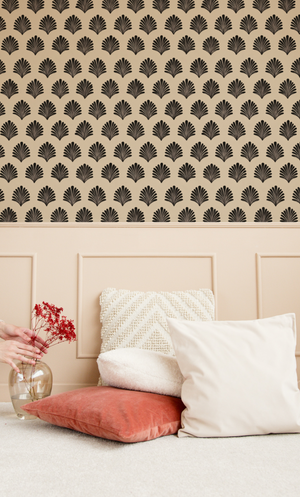
The 1920s brought Art Deco geometry and bold contrast. Chevrons were everywhere, and sunbursts, with fans close behind. Florals went stylized, still carrying echoes of Charles Rennie Mackintosh and the Glasgow School from a generation before (we still think those look modern). After King Tut's tomb was opened in 1922, Egyptian Revival designs swept in. Metallic inks sold widely for the first time, gold and silver mostly, bronze too, and you'd see single-pattern repeats in high-contrast color.
The bigger change, a few decades on, was pre-pasted paper. Hangers used to mix wheat or animal-based paste on site; now the glue went on at the factory and all you added was water. Small thing? Not really. It pointed to where wallpaper was headed: faster and cheaper, and more accessible than ever.
What Did 1950s Wallpaper Look Like?
The post-war boom pushed the craft to its 20th-century peak, and the 1950s left behind two ideas that still matter. The first was vinyl coating. A thin layer over the print made wallpaper washable, scrubbable, and far tougher than paper alone. That finally opened the door to kitchens and baths, where humidity had always ruled paper out.
The second was sheer mass-market reach. Pattern catalogs ballooned, and the styles ran from atomic and starburst motifs to boomerangs and abstract geometrics, from cherries and kitchen themes (the kitchen was newly a showpiece) to pastel pinks, mint greens, and powder blues, with cowboy and western scenes for boys' rooms and dense, busy florals everywhere else. It went up at a scale the trade had never seen, in nearly every room of the typical suburban house. No decade reached further.
Why Did People Use Wallpaper Instead of Paint?
For most of the story, paint and paper simply did different jobs. Paper's first job was hiding things. Pre-war walls were lath and plaster, prone to hairline cracks and settling, and the texture was rarely even. Paint showed every flaw. Wallpaper covered the lot.
Color was the other reason. Ready-mixed paint in a wide range of colors only became ordinary in the mid-20th century, so for a long time paper was the easiest way to get color and pattern at all. A lot of paint meant white or off-white. A pattern book offered hundreds of motifs. Easy call.
Paper did quieter work too. Its layers soaked up sound and put a thin buffer against cold outside walls, the same comfort logic that once hung tapestries in castles. And it carried status: from the 1500s through the 1800s, a papered room was a luxury good or a hard-won middle-class marker.
The swing to paint started in the 1960s, when three things lined up at once. Drywall replaced lath and plaster and gave paint a smooth surface to sit on. Modern chemistry blew open the range of colors and finishes. Central heating did the rest, retiring the insulation argument entirely. Paint became the default, and pattern became the choice you made for special rooms.
The 1980s Decline and the 2010s Revival
The craft peaked around 1970 and then slid for a long while. The 1980s didn't help. Country-craft was big. So were mauve and burgundy. Add oversized florals and you had the whole look, which was shorthand for "dated" by the late 1990s. Removal services boomed as people stripped it off layer after layer. By the 2000s the category had nearly vanished. Magazines dropped it and new builds skipped it. You mostly saw it at your grandparents' place.
Around 2015 it started coming back. Peel-and-stick did a lot of that by making hanging easy for renters and beginners. Social media rewarded visual depth. And the all-white minimalism of the 2010s had worn thin. By 2020 it was back in the major design magazines. By 2026? A mainstream choice once more. For where things stand now, see our piece on Is Wallpaper Back in Style?.
Frequently Asked Questions
When was wallpaper first used in homes?
Decorated paper is said to have lined Chinese homes from the 200s BCE, and reached European homes in the late 1400s. Europe's oldest surviving piece is English, from 1509, and it turned up on the beams of Christ's College, Cambridge.
Where was wallpaper invented?
In two places, independently. Popular accounts put decorated paper on Chinese walls around the 200s BCE. Europe followed in the late 15th century with Italy and France out front, and yet the oldest surviving examples are English. Funny how that goes.
How was wallpaper originally made?
By hand, either hand-painted onto single sheets in watercolor or woodblock-printed from carved blocks pressed onto paper. Every color took its own block, so a multi-color roll could need 8 to 30 separate impressions. Machines? Not until roller printing took over in 1839.
What changed wallpaper design in the 19th century?
Two opposing forces. Roller printing made it cheap and mass-market from 1839 on. The Arts and Crafts movement pushed back with hand block-printed botanicals on premium paper, and we'd say it won the long game: several of those 19th-century patterns are still in production today.
What did wallpaper look like in the 1920s?
It leaned into Art Deco geometry, stylized florals, Egyptian Revival motifs (after Tut's tomb in 1922), and metallic gold, silver, and bronze inks. Pre-pasted paper showed up that decade too. Just add water.
What did 1950s wallpaper look like?
Atomic and starburst motifs, boomerangs, kitchen themes like cherries and fruit, pastel pinks, mints, and powder blues, and cowboy scenes for kids' rooms. The 1950s also brought vinyl coating, which made paper washable for the first time (that's what finally got it into kitchens).
Why did people use wallpaper instead of paint?
It hid wall flaws that paint exposed, delivered color and pattern that paint couldn't until modern chemistry arrived, buffered sound and cold in homes without central heat, and signaled status for much of its history. That held until drywall and modern paint came along. Once central heating spread as well, paper's edge mostly went away.
Our Take
Outside of paint itself, no home finish has a longer continuous run than this one. Five centuries in Europe, two thousand years in China, through every major shift in money and technology the world has thrown up since. The printing techniques and the motifs turn over every generation. The pull toward putting depth and pattern on a wall hasn't budged.
If the history leaves you wondering which patterns have aged best, the most trend-proof ones tend to be the oldest: toile, grasscloth, classic stripes, and botanical illustration are all still in steady use. Our piece on Is Wallpaper Back in Style? covers what's in and what's out, and for the wider category, see our Types of Wallpaper.
Last updated: May 2026.


