

How to Wallpaper a Corner
Corners are where most wallpaper installs go wrong. The wall is not perfectly plumb, the corner itself is not sharp, and a single strip wrapped around the corner will buckle, lift, or pull at the seam over the next few weeks. The right wallpaper corner technique is two short strips with a small overlap, not one long strip wrapped around. Hang wallpaper in a corner the right way and the rest of the wall reads as seamless.
This guide covers inside corners, outside corners, uneven corners, how patterns match across a wallpaper corner, and how the technique differs between traditional and peel and stick wallpaper.
Why Wallpaper Corners Are the Hardest Part of a DIY Install
Three things go wrong at a wallpaper corner. First, a corner looks like a clean vertical line from a few feet away, but almost no wall corners are perfectly vertical. Hold a level against yours and it's usually off by a fraction of an inch from top to bottom. Wrap a strip around that drift and it puckers.
The edge isn't sharp, either. Drywall mud and paint buildup round it off into a slight radius, and a single strip can't lie flat through that curve without lifting. Then there's the slow stuff. Humidity, temperature and plain settling move a wall a little with the seasons, and the corners are where you see it first. No wonder they're the tricky part of anyone's first attempt at wallpaper.
Here's the good news. The pro fix is the same for all three problems: cut at the corner, overlap a small wrap, and hang the next wall as a fresh start with its own plumb line. It sounds fussier than it is (walk through it once and it clicks).
Preparation: Tools and Materials
Good preparation for a corner install is mostly about discipline with three tools: a smoothing tool for pressing the panel flat without trapping air bubbles, a soft-bristle brush for working the wallpaper into the corner from top to bottom, and a sharp trimming knife with a fresh blade for cutting the excess paper away at the ceiling and floor. The Tempaper installation guide sums up the install challenge: "Working around corners and smoothing out bubbles is a breeze." That step-by-step idea holds for traditional paste-the-wall wallpaper and for peel-and-stick alike. Finish the corner before you move to the next wall, and never assume it's plumb.
Here's what to have within reach before you start:
- A 4-foot level, which you'll lean on for every plumb line
- A sharp snap-blade knife and spare blades (put a fresh one in for every wall)
- A 6-inch metal straight edge, or a wide putty knife
- A plastic smoothing tool or squeegee
- Pencil and tape measure
- A damp sponge or rag for wiping leftover wallpaper paste off the seams, since paste washes away with a damp rag while it's still wet
- Wallpaper seam adhesive, for finishing the overlap edge
How to Hang Wallpaper in an Inside Corner: Step by Step
The most common case in residential rooms. Plenty of inside corners in a typical home meet at near 90 degrees, but never exactly, and that small miss shapes everything below.
Start on the first wall. Hang the strip leading up to the corner as normal, smoothed down its full length. Now measure from that strip's seam to the corner, and do it at several heights (top, middle and bottom), because the numbers rarely agree. Take the longest one and add 1/2 inch.
That's the width of your next strip. The extra 1/2 inch is what wraps onto the second wall, so before the piece goes up, check that your cut is square. Then hang it against the previous strip's seam and let the extra fold into the corner and onto the second wall. The section nearest the corner should sit flat without forcing.
Press hard. With your smoother or a putty knife, push the wrap firmly into the corner until it lies flat. Any air bubbles around the corner get worked out gently while you smooth, and you chase each one outward toward the edge, so the air has somewhere to go, instead of pressing down on it.
Now move to the second wall. Measure 1/2 inch out from the corner and drop a fresh plumb line there, since that's where the next strip's edge will land. Cut that strip to full width with a sharp snap-blade knife so you get a square edge, and hang it to the new line. Its edge sits 1/2 inch from the corner, which means it overlaps the wrap from the previous strip by 1/2 inch. Smooth the overlap flat. Once the corner is cut and pressed, that overlap is intentional and almost invisible.
Last comes the trim. Use the same sharp knife against a straight edge at the ceiling and the floor, and take the excess off the top and bottom in one continuous motion for a neat line.
Why an overlap and not a butt seam? Corner walls drift. A butt seam at a corner will gap within weeks, while a 1/2 inch overlap absorbs the drift without showing.
How to Hang Wallpaper Around an Outside Corner: Step by Step
The corner where two walls meet at a convex angle (think the corner of a chimney that protrudes into a room, or the edge of a built-in cabinet). This is the one case where you literally wrap around the corner.
The start is the same as before: hang the strip leading up to the outside corner as normal. Then measure from that strip's seam to the corner and add 3/4 inch, which is slightly more than the inside corner wrap. If the corner is uneven, go to around 2 inches. Cut your strip to the measurement plus the 3/4 inch and hang it so the extra wraps around the corner onto the next wall.
Don't wait on the next part. Press firmly into the corner and tack the wrap edge down before the paste sets, so the wrap lies flat.
Over on the next wall, drop a fresh plumb line 3/4 inch from the corner. The next strip is cut to full width and hung to that line, with its edge landing right on it, which puts it 3/4 inch over the wrap. Once everything is smoothed, take a sharp utility knife and trim any small drift in the overlap, running it along a metal straight edge held to the corner edge so the cut stays clean. Wipe any paste off the face with a damp rag before it dries.
So why the bigger wrap? On a convex edge the wallpaper has to flex around the corner, and it keeps trying to flatten back out. Give an outside corner only 1/2 inch and the wrap often pulls back over time. While the paste is still wet you can reposition as much as you need to, and the paper will slide gently into place without tearing.


How to Wallpaper an Uneven Corner
Older homes often have corners that are not even close to plumb. Say you hold a level to one and it's 1/2 inch out of vertical from top to bottom. Layered paint, rounded drywall mud or general settling can all do it.
You handle it with the same measuring habit from the inside corner steps. Measure at the top, middle and bottom, and use the longest measurement as your wrap reference. At the narrower heights the wrap will be too long, and that's fine, because the excess can be smoothed flat or trimmed flush with a sharp snap-blade knife that follows the corner edge as you cut.
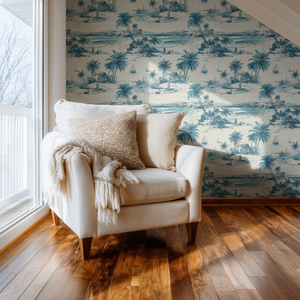
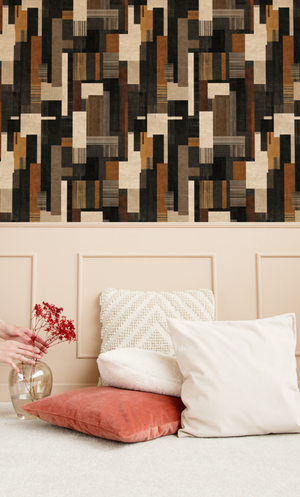
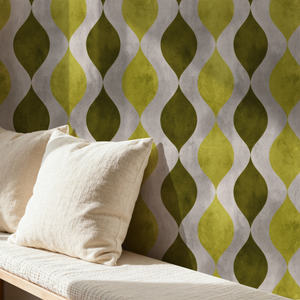
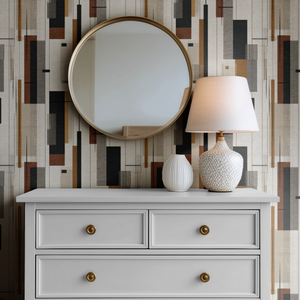
What if the drift is worse, more than 1 inch from top to bottom? You could float a thin strip of joint compound to flatten the worst of the drift before you hang any wallpaper. Or you could let the pattern carry it. A wallpaper pattern with strong vertical elements distracts from the visual mismatch, and a busy or random pattern hides the alignment issue while giving the wall depth and dimension.
Solid colors amplify an uneven corner. So do geometric patterns and stripes. Floral and abstract patterns hide it.
How to Wallpaper a Corner with a Pattern
Pattern matching at a wallpaper corner adds one decision: where the patterns match (or do not) after the corner. The right call depends on the room.
In most corner installs the pattern intentionally doesn't match perfectly across the corner. Your 1/2 inch overlap eats part of the pattern, so the new wall starts with it slightly shifted. That's industry standard. In a real room, when you decorate around the corner with consistent trim, it just reads as normal.
Sometimes you do need a tight pattern match, which is rare in residential work and common in high-end commercial jobs. If that's you, hang the corner strip with its wrap as normal. For the next strip, ignore the plumb line and align the pattern to wherever the corner strip's pattern picks up at the wrap edge. That strip may not end up perfectly plumb, and you'll have to accept it. The drift is invisible at the start, since the pattern matches, but it compounds as you keep going across the wall. Plan ahead for an inconspicuous spot where you'll drop a fresh plumb line and absorb it.
For most homes, though, the small shift across a corner is the right tradeoff. It's barely noticeable, and it keeps pattern drift from compounding across several walls. Tips and tricks from pro installers (the kind you'll see in every wallpaper tutorial making the rounds on the internet and YouTube) usually land in the same place. Small shifts beat compounded drift.
Do You Overlap Wallpaper at Corners?
Yes, always at corners. Modern wallpaper is generally designed for butt seams in the middle of a wall, with no overlap at all, but corners are the exception, and a 1/2 to 3/4 inch overlap is what you need for the install to last.
Put the overlap on whichever side is more likely to be in shadow. On an inside corner, that means hiding the overlap edge against the wall that gets less direct light. Outside corners are less tidy. The overlap is usually visible from one angle but not the other, so choose accordingly and the wall still reads as one piece.
How to Wallpaper a Corner with Peel-and-Stick Wallpaper
The same principles apply, with one wrinkle. Peel and stick wallpaper holds on with pressure-sensitive glue, and that glue is less forgiving of overlaps than traditional wallpaper paste. If it doesn't grip the wallpaper face beneath it, the overlap can lift over time.
So two things change. The wrap gets shorter, 1/4 inch, to keep the overlap area small. And the overlap needs real pressure: press it firmly with something that gives you local pressure, like a credit card or a burnishing tool, and hold it for 30 seconds so the glue gets as much contact as it can. During the first minute you can still reposition as needed, because peel-and-stick lets you lift it and set it back gently while you line things up.
Overlap still lifting after the install? A small amount of clear-drying craft glue under the lifted edge re-adheres it cleanly. For the full peel-and-stick process, see our How to Apply Peel and Stick Wallpaper. And the overlap rule you use at corners applies around windows and door frames too.
Common Wallpaper Corner Mistakes
The big one is wrapping a single strip around an entire corner. The wallpaper buckles or lifts within weeks. Close behind it is not dropping a fresh plumb line on the new wall, because if you just continue the alignment from the previous wall, any drift it had keeps compounding.
Wrap length goes wrong in both directions. Make it 2 inches and it's harder to hide and more likely to bulge at the corner. Cut it to 1/4 inch on traditional wallpaper and there isn't enough to absorb the wall's drift (1/4 inch is the peel-and-stick number, remember).
People also forget to press the corner, or press it with a bare hand, which isn't enough. The wrap needs firm pressure from a smoothing tool or putty knife to lay flat. Butt seams are another trap. Corners drift, butt seams gap, so always overlap. And watch for residual paste at the seams. It dries shiny and dulls the finish, but washed away with a damp rag while it's wet, it leaves no trace.
Frequently Asked Questions
How should I wallpaper a corner?
Cut at the corner, do not wrap. The strip on the first wall ends with a short wrap onto the second wall, 1/2 inch for an inside corner or 3/4 inch for an outside one. The next strip starts on the second wall at a fresh plumb line and overlaps that wrap, and you press the smoothing tool firmly into the corner so the wrap lies flat.
How do you wallpaper an inside corner?
Trim the first strip with a 1/2 inch wrap onto the second wall. Your plumb line goes 1/2 inch out from the corner, and the next strip hangs to it, right over the wrap. Then trim the excess paper off the top and bottom with a sharp blade.
How do you wallpaper an outside corner?
Same principle as inside corners but with a 3/4 inch wrap (slightly larger because the wallpaper has to flex around the convex edge). Press firmly at the corner edge and trim any small drift.
How do you wallpaper an uneven corner?
Take the longest measurement from any height (top, middle, bottom) of the corner and use that as your wrap. The excess at the narrower heights either smooths flat or trims flush. If you're looking at more than 1 inch of drift, consider skim coating the corner flat first, or choose a pattern that hides the drift.
Our Take
Most wallpaper failures at corners trace back to one decision: trying to wrap a single strip around a corner instead of cutting and overlapping. Wrap-and-overlap adds 5 minutes per corner. In exchange it prevents nearly every type of corner-related failure, from buckling and lifting to gapping and pattern drift. We'd take that trade every time.
On a first room, drop a fresh plumb line on each new wall before anything else. Let the pattern shift a little across corners, because that's normal. And give outside corners the wider 3/4 inch wrap. For the rest of the install, our How to Hang Wallpaper covers prep and first-strip alignment, plus pattern matching and trim.
Last updated: May 2026.


